
A Long Island Company's AI Reads the Bills Nobody Checks, and Only Gets Paid If It Finds Money
AIME audits a vendor statement line by line in minutes, takes nothing up front and is paid out of what it recovers. No switching vendors, no integration.
By Melville Chamber of Commerce ·
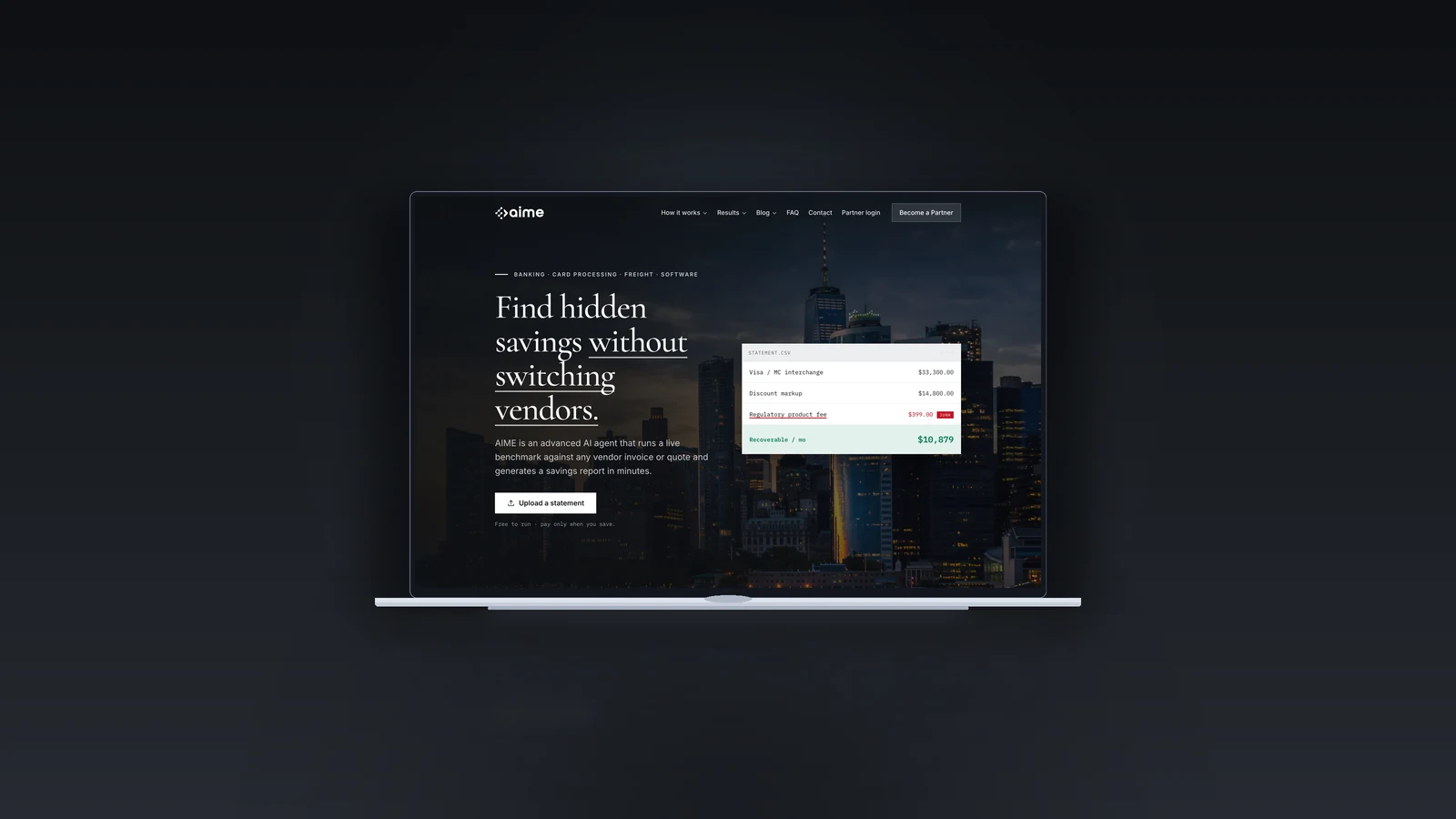
A Long Island company has built something worth a look for any member who pays a vendor every month. AIME is an AI agent that reads a bill, benchmarks it line by line and tells you what on it should not be there. It is free to run, and it is paid only out of what it finds.
The businesses it is aimed at are the ones on this roster: restaurants, medical practices, distributors, shops, the firms with real vendor spend and nobody whose job is to check it. A large company has a treasury department for this. Everybody else approves the invoice, files it, and treats the number as the cost of doing business.
What it does
You upload a statement. A bank statement, a merchant services bill, a freight invoice, a software renewal, a quote you have been handed and are not sure about. It accepts a PDF, a spreadsheet, a CSV or a photograph of a paper bill, and it will take anything from the last 30 days to three years of history, up to 50,000 pages.
It then builds a line-item breakdown and benchmarks each charge against what that charge should be, flagging the discrepancies, the fees that have quietly grown and the ones that are simply padding. The savings report comes back in minutes rather than the weeks a traditional audit takes. The company has also published a walkthrough of the same pass done by hand, line by line down a merchant services statement. There is a live version on hiaime.com with sample files on it, so you can watch it work on somebody else's statement before you hand it your own.
The part that matters to a small business
Fee recovery is not a new service. What has always kept it away from Main Street is the shape of the deal: a consultant, a retainer, an engagement long enough to justify the hours, and a minimum spend most Chamber members do not hit.
AIME's stated terms are nothing up front, no retainers and no hourly fees. It is paid on a contingency basis, as a share of the savings it recovers, and if it finds nothing you pay nothing. Because an AI agent is doing the reading, the economics work on a bill far smaller than a consultant could ever look at.
Two other things lower the barrier. It does not require switching vendors, which removes the usual objection that the disruption costs more than the savings. And it needs no integration: it reads the document you send it rather than connecting to your systems, so there is no API, no access to card or customer data, and no IT project attached.
The company says it has monitored more than $100 billion in vendor spend across banking, cards, freight and software, and that as much as 20 percent of controllable spend is lost to quiet fee drift.
Why it is timely
A federal judge in Brooklyn gave preliminary approval on June 9 to the $38 billion settlement between Visa, Mastercard and more than 12 million American merchants. It cuts interchange by a tenth of a percent for five years and caps the rate on a standard consumer credit card at 1.25 percent for eight.
Here is the catch, and it is the reason a tool like this is worth knowing about right now. What you pay to accept a card is three things stacked on one line: interchange, which goes to the bank that issued the card, assessments, which go to Visa or Mastercard, and your processor's own markup. The settlement reaches the first. It does not reach the third, and the third is the only one anybody negotiates. The company sets out where each of those three parts ends up in more detail.
A processor squeezed on the part it does not control has an obvious place to look for the difference, and markup does not arrive as a rate change with a letter attached. It arrives as a line item: a monthly fee that was five dollars and is now nine, a PCI compliance charge, a network access item, a small percentage added to a category of transaction that did not carry it last year. Reading that is exactly the job AIME was built for.
It is not only card fees
Card processing is the example this month because a judge put a number on it. The mechanism is general, and every member will recognize at least one of these. Waste hauling contracts with an annual escalator nobody diaried. Telecom bills still carrying circuits for a location that closed. Freight invoices with accessorial charges that were negotiated away two contracts ago. Software seats for people who left, which the company covers separately in a piece on seats, shelfware and renewal escalators. In every case the charge is small, the invoice is long, and the person who would notice is busy running the business.
There is a second door, for the people who already read your books
AIME also runs a partner program, which is worth knowing about if you are the accountant, the broker or the consultant in the room rather than the owner. A partner makes an introduction, AIME runs the audit, and the partner earns recurring income from what it recovers. There is a back office with the scanning and analysis tools in it, so an adviser can run the work themselves rather than handing a client away.
For a Chamber roster that is largely professional services, that is the more interesting half. The specialist knowledge of what a fair rate looks like in one industry is exactly what the tool cannot supply on its own.
Disclosure: AIME is not a Chamber member. Wave Agency, which is, built its website.
What this means for members
Pull one statement this week and run it. It costs nothing to find out, and the worst outcome is confirmation that you are being billed what you agreed to, which is worth knowing on its own.
And whatever the tool says, work out your own effective rate while you have the statement open: add up every fee on it and divide by the volume you ran that month. That percentage is what accepting cards actually costs your business, it is the one figure that cannot be hidden inside a line item, and once the settlement's rates take effect it is how you will know whether the saving reached you or stopped somewhere along the way.